Unicode Converter
Character Inspector
- Paste the text you want to convert in the input box
- The tool automatically detects the input format (Unicode escape, HTML entity, URL encoding, etc.)
- Decoded or encoded result is displayed automatically
- Click "Copy Result" button to use
Help
FAQ
What is a Unicode escape sequence?ShowHide
What's the difference between Unicode and UTF-8?ShowHide
Why do %XX appear in URLs?ShowHide
What's the relationship between HTML entities and Unicode?ShowHide
How to handle Emoji?ShowHide
Quick Start
- Paste the text you want to convert in the input box
- The tool automatically detects the input format (Unicode escape, HTML entity, URL encoding, etc.)
- Decoded or encoded result is displayed automatically
- Click "Copy Result" button to use
Privacy Notice
Full guide
Unicode Converter
What is Unicode?
Unicode is a character encoding standard that assigns a unique number (code point) to every character in the world. Each character has a unique Unicode code point, for example:
- "A" has code point U+0041
- "中" has code point U+4E2D
- "😀" has code point U+1F600
Why Do We Need Unicode Encoding/Decoding?
In programming and network transmission, certain characters cannot be used directly and need to be converted to specific formats:
| Scenario | Encoding Format | Example |
|---|---|---|
| JavaScript strings | \uXXXX escape | "Hello" → "\u0048\u0065\u006C\u006C\u006F" |
| HTML pages | &#x...; entity | "中" → 中 |
| URL addresses | %XX percent encoding | "Hello" → %48%65%6C%6C%6F |
| CSS content | \XXXX escape | "中" → \4E2D |
Usage Guide
Quick Start
- Paste content: Paste the text you want to convert in the input box
- Auto-detect: The tool automatically detects the input format
- View result: Decoded or encoded result is displayed automatically
- Copy: Click the "Copy Result" button
Common Use Cases
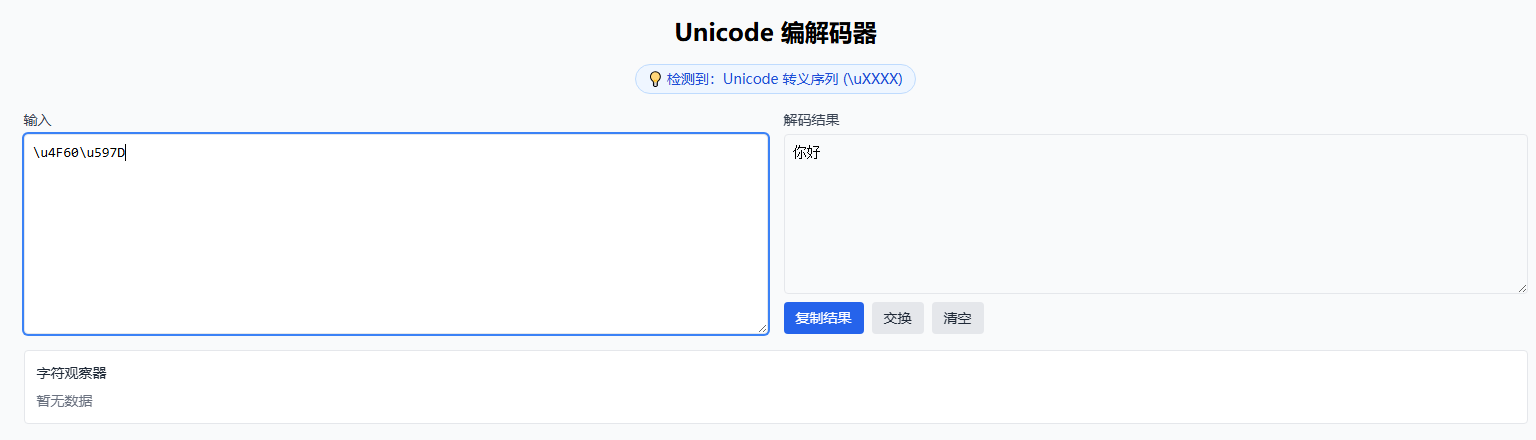
Case 1: Decode Unicode Escape
When you see a string like \u4F60\u597D and want to know what it means:
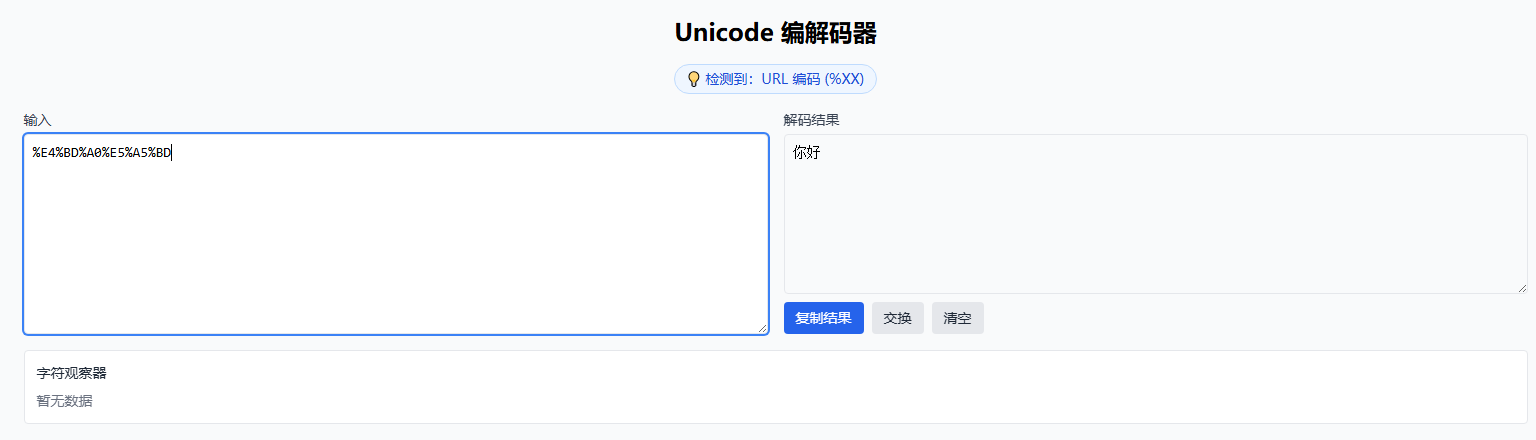
Case 2: Decode URL Encoding
Chinese characters in URLs are usually encoded as %E4%BD%A0 format:
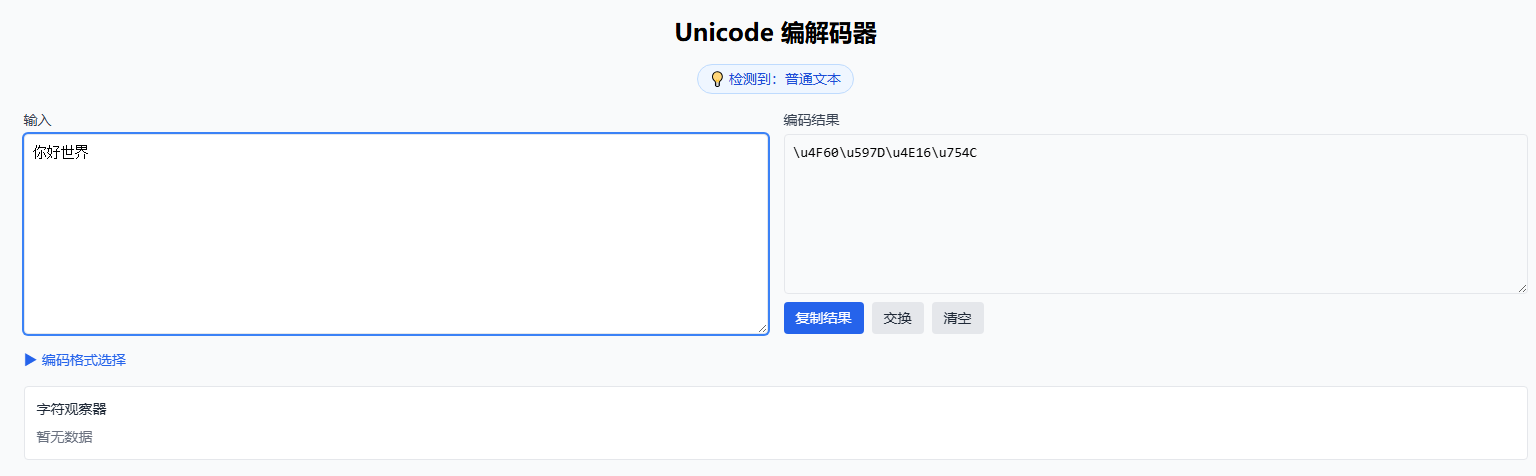
Case 3: Encode Text to Unicode
When you need to use Chinese in JavaScript:
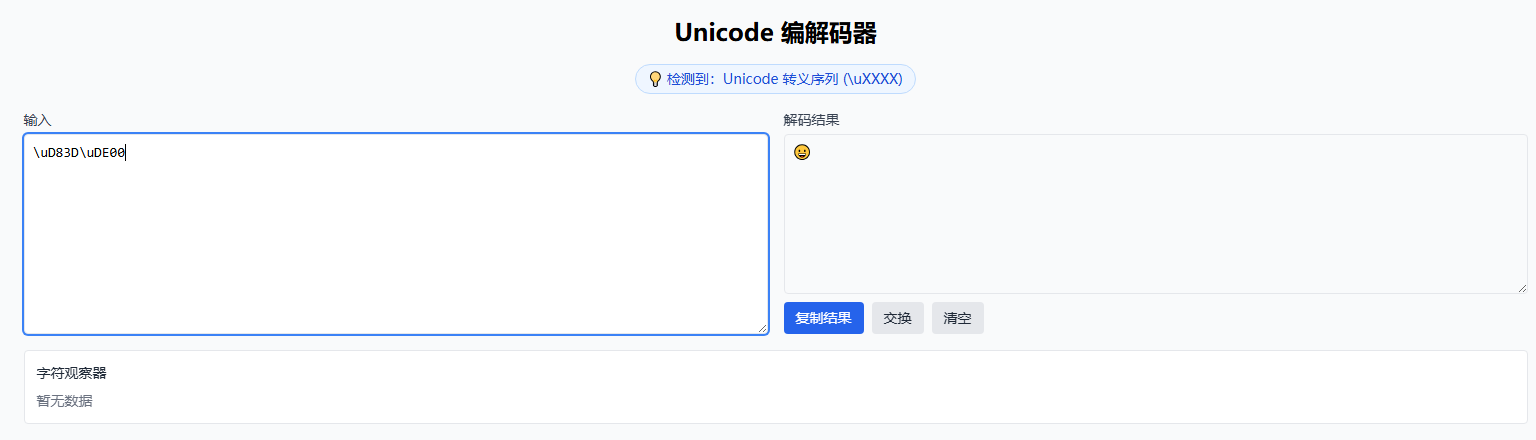
Case 4: Handle Emoji
Support for Emoji encoding and decoding:
Advanced Options
When the input is plain text, click "Encoding Format" to choose different encoding formats:
- Unicode Escape: For JavaScript/JSON
- HTML Entity: For HTML pages
- CSS Escape: For CSS content property
- URL Encoded: For URL parameters
FAQ
What is a Unicode escape sequence?
A Unicode escape sequence is a way to represent Unicode characters in programming languages. The format is \u followed by 4 hexadecimal digits, such as \u4F60 representing "你". For characters beyond U+FFFF (like Emoji), surrogate pairs are used, such as \uD83D\uDE00 for 😀.
What's the difference between Unicode and UTF-8?
Unicode is a character set standard that assigns a unique number to each character. UTF-8 is an encoding method for Unicode that converts code points into 1-4 byte sequences. For example, "中" has Unicode code point U+4E2D, and UTF-8 encoding is E4 B8 AD (3 bytes).
Why do %XX appear in URLs?
URLs can only contain ASCII characters. Non-ASCII characters like Chinese need to be percent-encoded. Each byte is represented as %XX, where XX is a two-digit hexadecimal number. For example, "你" has UTF-8 encoding E4 BD A0, which becomes %E4%BD%A0 after URL encoding.
What's the relationship between HTML entities and Unicode?
HTML entities are a way to represent special characters in HTML. You can use odepoint; or &#decimalcodepoint;. For example, 你 and 你 both represent "你".
How to handle Emoji?
This tool fully supports Emoji processing. Emoji usually have code points beyond U+FFFF and require special handling:
- 😀 has code point U+1F600
- Unicode escape:
\uD83D\uDE00(surrogate pair) or\u{1F600}(ES6) - URL encoding:
%F0%9F%98%80
Related Tools
- Base64 Encoder/Decoder - Base64 encoding and decoding
- URL Encoder/Decoder - URL encoding and decoding
- JSON Formatter - JSON formatting and minification